Pearson Edexcel · A-Level · Economics B
Course version: 9EB0 · Version from Sept 2015
Barriers to entry: c) The impact of barriers to entry on market structure
Barriers to entry are obstacles making it difficult for new firms to enter a market.
Checked against the Pearson Edexcel 9EB0 specification (opens in a new tab) on .
- Point 3 of 4
- 2 key terms
Study notes
From the checked teaching notes for this specification point.
The idea
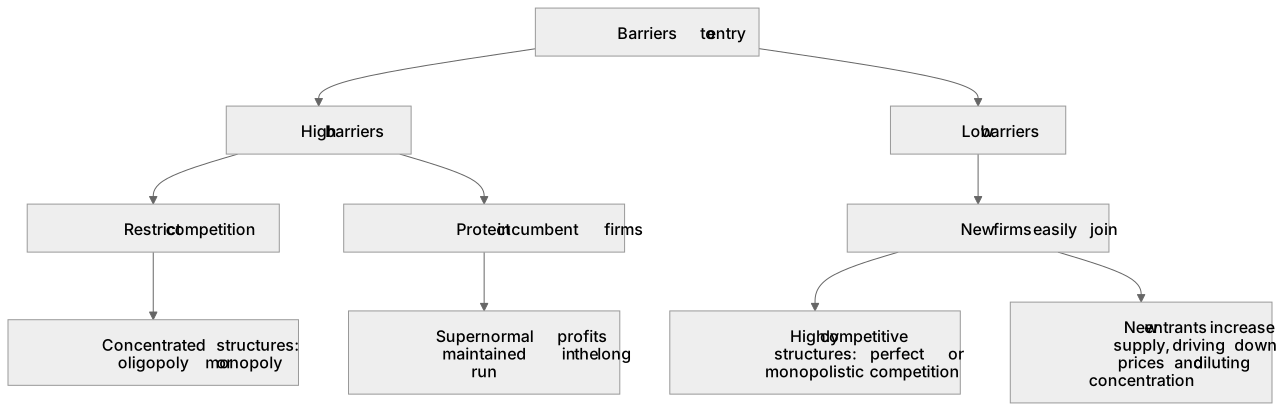
Barriers to entry are obstacles making it difficult for new firms to enter a market. Their presence directly determines market structure. High barriers, such as significant capital requirements or patents, restrict competition and lead to concentrated structures like oligopolies or monopolies. For example, the pharmaceutical industry requires massive R&D investment, creating an oligopoly. Conversely, low barriers allow new firms to easily join the market, resulting in highly competitive structures such as perfect or monopolistic competition. When barriers are low, supernormal profits attract new entrants, which increases supply, drives down prices, and dilutes market concentration over time, preventing long-term monopoly power.
What earns the marks
- Identify how high barriers to entry lead to concentrated market structures like monopoly or oligopoly.
- Explain that low barriers to entry facilitate highly competitive markets such as perfect or monopolistic competition.
- Recognise that barriers to entry protect incumbent firms from new competition, allowing them to maintain supernormal profits in the long run.
- Evaluate how changes in barriers to entry can shift a market from a monopoly towards a more competitive structure.
Common mistakes and how to put them right
Assuming barriers to entry only affect new firms.
Put it right: They also protect incumbent firms by reducing the threat of competition and safeguarding market share.
Confusing barriers to entry with barriers to exit.
Put it right: Barriers to entry prevent firms from joining a market, whereas barriers to exit prevent them from leaving.
Believing that monopolies always have absolute barriers to entry.
Put it right: Barriers can be high but not insurmountable, and technological changes can lower them over time.
Exam tips
- When analysing market structure, always explicitly link the level of barriers to entry to the number of firms and the degree of competition.
- Use specific examples of barriers, such as legal patents or structural economies of scale, to justify why a market is an oligopoly or monopoly.
- Remember that in multiple-choice questions, the defining characteristic separating monopolistic competition from oligopoly is often the height of the barriers to entry.
Try the lesson
The start of the Barriers to entry: c) The impact of barriers to entry on market structure lesson, made from checked teaching notes for this specification point.
Have a go first
What is the most likely impact of high barriers to entry on the structure of a market?
Listen
Barriers to entry are obstacles making it difficult for new firms to enter a market. Their presence directly determines market structure. High barriers, such as significant capital requirements or patents, restrict competition and lead to concentrated structures like oligopolies or monopolies. For example, the pharmaceutical industry requires massive R&D investment, creating an oligopoly. Conversely, low barriers allow new firms to easily join the market, resulting in highly competitive structures such as perfect or monopolistic competition. When barriers are low, supernormal profits attract new entrants, which increases supply, drives down prices, and dilutes market concentration over time, preventing long-term monopoly power. A strong answer earns marks for these points. Identify how high barriers to entry lead to concentrated market structures like monopoly or oligopoly. Explain that low barriers to entry facilitate highly competitive markets such as perfect or monopolistic competition. Recognise that barriers to entry protect incumbent firms from new competition, allowing them to maintain supernormal profits in the long run. Evaluate how changes in barriers to entry can shift a market from a monopoly towards a more competitive structure. A common slip: Assuming barriers to entry only affect new firms. Instead, they also protect incumbent firms by reducing the threat of competition and safeguarding market share. Exam tip: When analysing market structure, always explicitly link the level of barriers to entry to the number of firms and the degree of competition.
See it
Key words
Say what each word means before you turn the card.
Market structure
Try answering aloud or in your head before turning the card.
Monopoly power
Try answering aloud or in your head before turning the card.
See every definition
- Market structure
- The organisation of a market, determined by the presence of barriers to entry, ranging from concentrated forms like oligopolies or monopolies to highly competitive forms such as perfect or monopolistic competition.
- Monopoly power
- A position held by incumbent firms protected from new competition by barriers to entry, allowing them to maintain supernormal profits in the long run.
Label the diagram
Some boxes have lost their names. Pick the right name for each number.
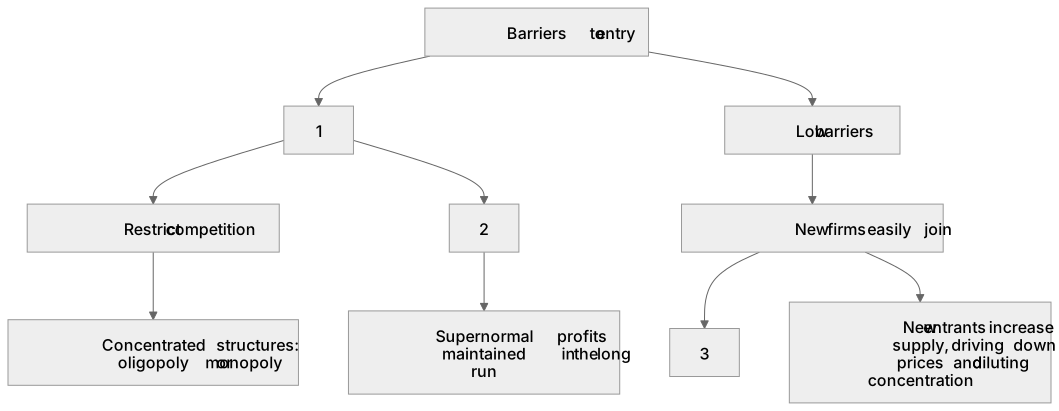
1Box 1
2Box 2
3Box 3
There is more to this lesson
The full lesson goes on to check your understanding and help you earn the marks. Create a free account to carry on, with your progress saved.
A week of Premium from your first lesson · Then the free plan continues · No card, no charge
Test your understanding of Barriers to entry: c) The impact of barriers to entry on market structure
Active recall beats re-reading. Take an instant quiz now to test what you’ve learned and lock it into long-term memory.
A week of Premium from your first lesson · Then the free plan continues · No card, no charge